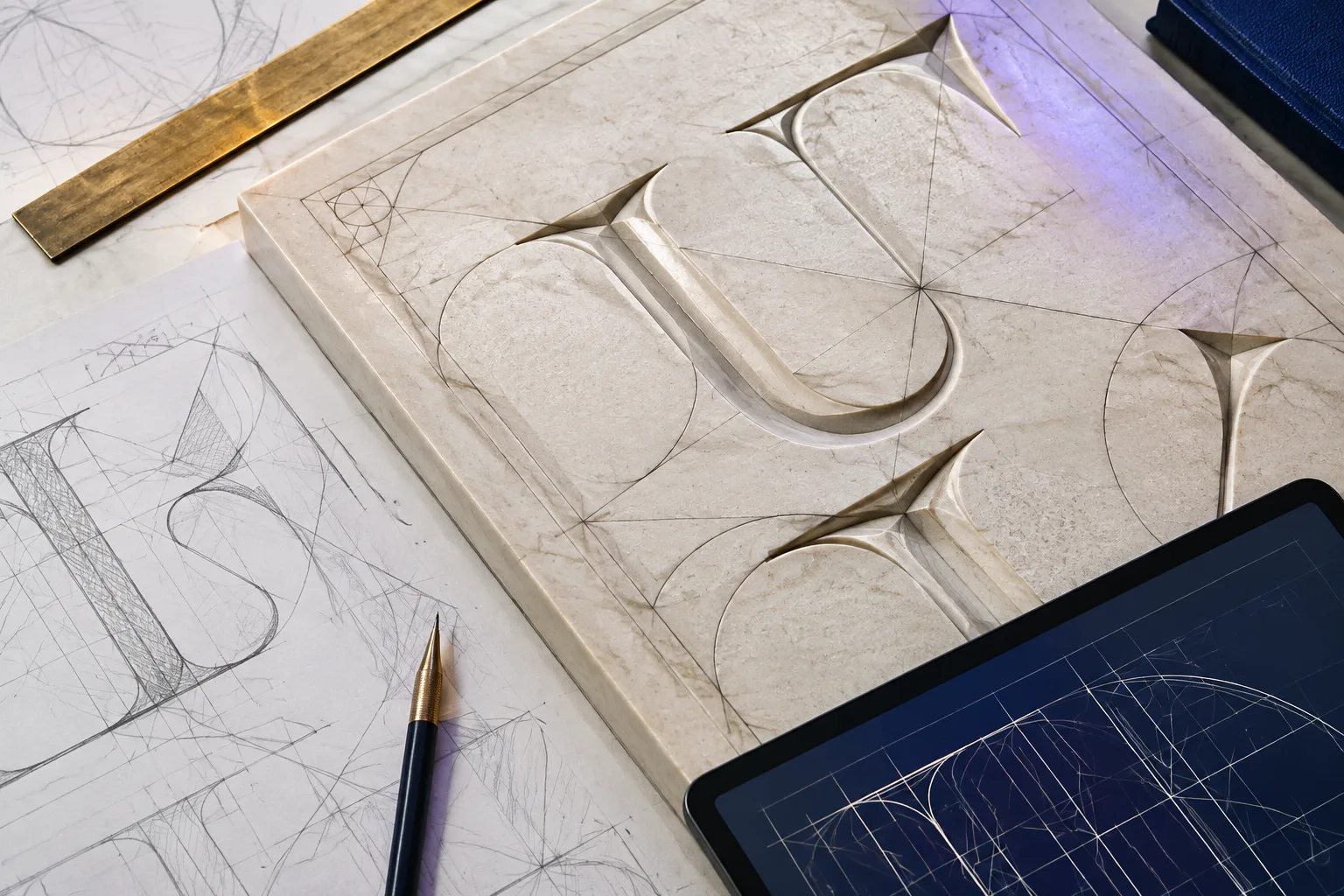
Realistic rendering can make an invented panel look catalogued and a copied texture look quarried. Historical status therefore cannot be judged by polish. It depends on a traceable object, evidence, explicit uncertainty and an accurate caption.
Start with the object claim
Ask what the image says it depicts. A photograph of a catalogued object should name collection, object number, maker or attribution, date and material where known. The British Museum’s marble gravestone record, for example, identifies inscriptions, date range, findspot and material.
Our lettering illustration supplies none of that because it shows an invented studio composition. Its curved serif fragments are design studies, not a transcription of an ancient inscription. Similarity to stone lettering cannot create provenance.
A reconstruction needs an evidence trail
An evidence-based reconstruction identifies the surviving remains and explains how missing parts were proposed. Dimensions, comparative examples and uncertainty should be accessible to the reader. High resolution and dramatic lighting are not substitutes for documentation.
A hypothetical proposal may still be valuable when labelled. The critical distinction is whether the image enables a reader to separate measured evidence from filled gaps. Without that trail, “classical-inspired concept” is the more accurate category.
Revival architecture has its own date
The British Museum building uses Greek architectural language but belongs to the nineteenth century. Its columns and portico are documented historical architecture, yet they are not ancient Greek remains. “Historical” and “ancient” are not synonyms.
This middle category prevents a false choice between ancient original and modern fantasy. Renaissance, Neoclassical and Greek Revival works can cite classical forms while answering different institutions, materials and construction systems.
Use a four-line caption
A strong caption can state creator, date, subject and image status. Useful status terms include photograph, measured drawing, evidence-based reconstruction, hypothetical reconstruction and contemporary concept illustration. Add collection and rights information where relevant.
If a licence cannot be verified, do not imply free reuse. This journal’s three original illustrations are recorded in Sources & Image Credits and delivered with their prompts. External museum pages are linked for research; their own rights statements apply.
Reading takeaway
Trust the evidence trail and caption, not visual polish, when deciding whether an image is historical reference or fantasy design.
Sources and scope
These references support the factual frame of this article. They do not endorse its contemporary illustrations or editorial interpretation.
- British MuseumMarble gravestone with Greek and Phoenician inscriptions
Museum catalogue record for a marble stele with documented Greek and Phoenician inscriptions, date, findspot and material.
- British MuseumGreek Revival architecture: simplicity and splendour
Evidence for later reuse of Greek architectural language in a nineteenth-century museum building.
- The Metropolitan Museum of ArtArchitecture in Ancient Greece
Temple plans, stone and wood construction, painted decoration, and the relationships that define architectural orders.
- The Metropolitan Museum of ArtItalian Renaissance Frames
Documented history of frames as architectural surrounds and of the ornamental vocabulary used to organise a central image.