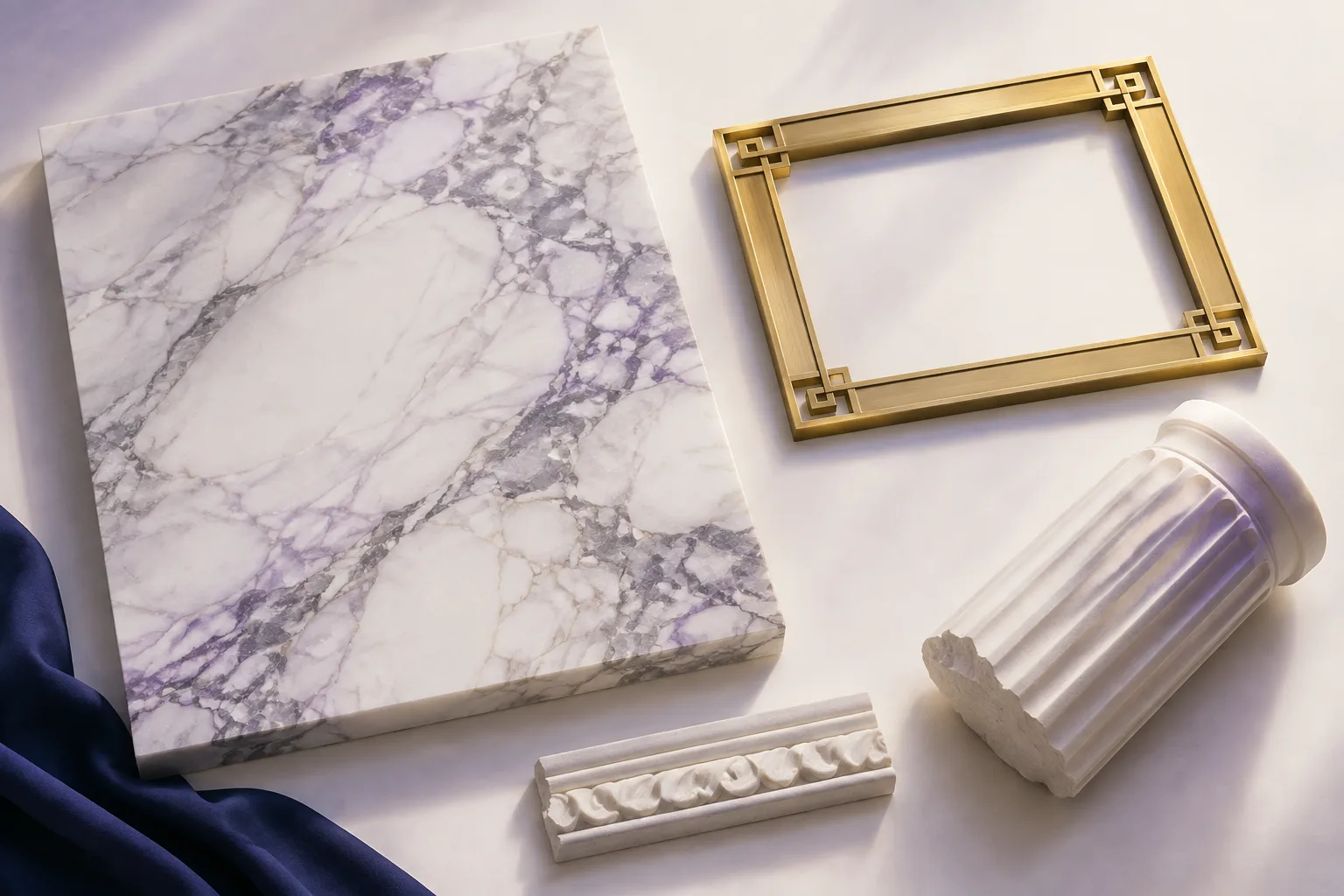
A frame is not only decoration around something more important. It mediates between a central field and its surroundings, sets a viewing distance, and makes alignment or imbalance visible. Its history is specific, but its compositional work can be analysed without inventing an origin.
A border creates an edge
The outer edge separates an image, inscription or panel from the wall around it. A plain narrow moulding makes a quiet transition; a deep profile and strong contrast produce a threshold. Width should be judged against the central field rather than in isolation.
The Met’s history of Italian Renaissance frames shows how architectural vocabulary moved into independent surrounds for paintings and reliefs. That documented tradition is later than ancient Greek temple architecture. Calling every gold rectangular border “classical” would erase the object’s actual date and context.
Corners reveal the construction
Corners are where linear runs meet and where a repeated motif must turn, stop or overlap. A mitred joint, carved leaf, rosette or geometric knot can conceal the transition or make it a focal point. The most useful description records form and placement before suggesting a stylistic family.
Our generated frame uses simple interlocking squares at the corners. They are fictional design details. The image does not supply evidence that they reproduce a historical ornament, and the journal does not name them after a culture or period.
Hierarchy needs restraint
A frame competes with its contents whenever contrast, depth or repetition becomes stronger than the central field. Reducing the number of motifs, widening the inner margin or simplifying the corner can restore hierarchy. Repetition can also support the centre by creating a predictable rhythm.
The cover illustration uses a thin double line, small corner leaves and a large uninterrupted marble field. The border reads clearly but remains subordinate to the journal title. This is a modern editorial decision rather than an archaeological claim.
Credit the object, not the resemblance
A historical frame should be captioned with maker or attribution, date, material, collection and source when available. “Attributed” and “probably” preserve catalogue uncertainty. An anonymous frame should remain anonymous rather than receive a creator inferred from appearance.
A new digital frame needs a different credit: creator, year, tools where relevant, rights holder and a statement that it is contemporary. When a modern design borrows documented motifs, the source should be named without implying endorsement by the museum or collection.
Reading takeaway
Judge a frame by how it establishes edge, transition and hierarchy—and describe its origin only when evidence supports it.
Sources and scope
These references support the factual frame of this article. They do not endorse its contemporary illustrations or editorial interpretation.
- The Metropolitan Museum of ArtItalian Renaissance Frames
Documented history of frames as architectural surrounds and of the ornamental vocabulary used to organise a central image.
- The Metropolitan Museum of ArtArchitecture in Ancient Greece
Temple plans, stone and wood construction, painted decoration, and the relationships that define architectural orders.
- British MuseumGreek Revival architecture: simplicity and splendour
Evidence for later reuse of Greek architectural language in a nineteenth-century museum building.